

 wawstock
Plantago major, commonly known as broadleaf plantain or greater plantain, is a hardy little plant that grows in lawns, gardens, pathways, fields, and disturbed ground across much of the world.
Many gardeners consider it nothing more than a stubborn weed. But for generations, people have eaten its young leaves and used the plant in traditional herbal preparations.
And no—it has nothing to do with the banana-like fruit also called plantain.
How to Recognize Plantago major
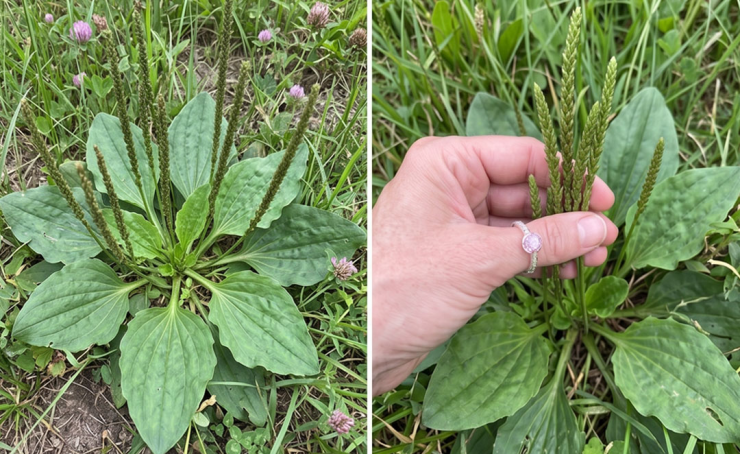
Broadleaf plantain usually grows as a low rosette close to the ground.
Look for:
Broad, oval green leaves
Several prominent parallel veins running through each leaf
Long leaf stalks
Thin, upright flower spikes
Tiny greenish-brown flowers and seeds along the spikes
One particularly noticeable feature is the strong, string-like veins inside the leaves. If you gently pull a leaf apart, these fibers can often be seen stretching between the torn sections.
Correct identification is essential before eating any wild plant.
Can You Really Eat Plantago major?
Yes. The young leaves of correctly identified Plantago major are edible.
Young leaves are generally the best choice because they are more tender and have a milder flavor.
They can be:
Added raw to salads in small amounts
Chopped into soups
Lightly sautéed
Cooked similarly to other leafy greens
Blended into savory green dishes
Older leaves become tougher and more fibrous, so cooking them usually makes them more pleasant to eat.
The flavor is earthy and slightly bitter.
Why Are People Eating This Backyard Weed?
One reason is surprisingly simple: it’s a readily available edible green that many people remove from their gardens without realizing it can be used as food.
Plantain leaves contain fiber and various naturally occurring plant compounds. Research on Plantago species has also identified compounds such as flavonoids, phenolic compounds, iridoid glycosides, and polysaccharides.
This combination of traditional food use and interesting phytochemistry has made the humble plantain much more fascinating than its reputation as a lawn weed suggests.
Plantago species have a long history in traditional herbal practices.
The leaves have traditionally been used externally on minor skin irritations, insect bites, and small superficial wounds. Various preparations have also historically been used for digestive and respiratory complaints.
Modern research has investigated Plantago major for potential anti-inflammatory, antioxidant, antimicrobial, and wound-related biological activities.
However, laboratory findings and traditional uses should not be confused with proven medical treatments in humans.
As the plant matures, it produces tall flower spikes containing numerous tiny seeds.
Plantain seeds contain mucilage, a substance that becomes gel-like when exposed to water.
This shouldn’t be entirely surprising: Plantago major belongs to the same genus as Plantago ovata, the plant whose seed husks are commonly sold as psyllium.
The two plants are different species, however, and broadleaf plantain should not simply be treated as a substitute for commercial psyllium products.
Broadleaf plantain is extraordinarily resilient.
It can survive compacted soil, repeated mowing, foot traffic, and conditions that cause many more delicate plants to disappear.
Its presence can sometimes be associated with heavily compacted or disturbed soil.
Instead of automatically pulling every plant you find, you might decide to leave a few in a clean part of your garden—particularly if you’re interested in edible wild plants.
If you want to try broadleaf plantain as food, where you harvest it matters just as much as identifying it correctly.
Avoid plants growing:
Along busy roads
In areas sprayed with herbicides or pesticides
Near chemically treated lawns
Where dogs or other animals frequently relieve themselves
On potentially contaminated soil
Choose healthy young leaves from a clean location and wash them thoroughly before eating.
Never eat a wild plant unless you are completely confident about its identification.
The leaves have traditionally been dried and steeped in hot water to make herbal infusions.
Plantain tea is sometimes promoted online for everything from coughs to digestive problems and inflammation.
While the plant contains biologically interesting compounds, claims that plantain tea can cure diseases, eliminate infections, or replace medication go far beyond what current evidence supports.
Think of broadleaf plantain primarily as an interesting edible and traditionally used herb—not a miracle medicine.
Perhaps the most fascinating thing about Plantago major isn’t one extraordinary health claim.
It’s the fact that an incredibly common plant hiding between paving stones and growing unnoticed in lawns has been eaten and used by people for generations.
Its young leaves are edible, its seeds contain mucilage, and its natural compounds continue to attract scientific interest.
So the next time you spot this familiar rosette growing in your backyard, don’t immediately dismiss it as useless.

Add comment